The Craft

RPPFI

Your genes lean towards focused precision. You shape what others imagine into something that lasts.

What your genes say

You understand an idea best once you have tried it out. A friend describes the kitchen they want, and before they finish you are sketching it on the back of an envelope. You move the sink, redraw the cupboards and see at once that the door will hit the fridge.

The Craft sketching building designs in a notebook at a desk, a small architectural model on the table beside them

Other people rarely see how much you changed. They just find the finished thing easy to use. What you want most is to make something that works in someone else's hands. What you fear most is putting your name on something shoddy. Like a carpenter, you learn your craft by making the thing, and you judge it by how well it works in use.

Some of this is learned. Some of it is biology, and that part has a name.

Yours is called The Craft.

The short version

You want to find out what an idea can actually do. You try it, learn from the result and make the changes that matter. A finished piece shows you how good the idea really is. To you, quality means it works well for the person who uses it.

We are what we repeatedly do. Excellence, then, is not an act, but a habit. Will Durant, The Story of Philosophy, 1926

Why DNA?

Think of DNA as a set of biological instructions written before you were born.

Your DNA does more than set your eye colour or height. Your genes also influence how your muscles are built, how your body produces energy, how your skin protects itself and how your brain processes information. Together, these biological settings help shape your DNA-Archetype.

They do not dictate your personality or your choices, but they can influence how your body naturally responds. Some things you have always thought of as ‘just me’ may have a biological layer too.

These are your factory settings. You did not choose them, but once you know them you can design around them.

The five settings that make you The Craft are: Resilient Body, Power Energy, Protected Skin, Focused Social Wiring, and Intuitive Mind.


Your five settings

Five settings make you The Craft. Each one explains a different part of how you naturally operate.

Physical R

Resilient

Your genes help shape the muscles and connective tissues that bear physical load. Strength, the force your muscles can produce, is one of the traits your genes influence here, and training builds on it. A Resilient tendency points towards a body that can become dependable under familiar demands. With practice, a movement that once felt difficult may begin to feel secure.

You may notice it when lifting, carrying or doing an exercise you know well. You recognise the weight and know how to handle it. That physical confidence can be satisfying in itself.

You may not think much about this capacity until an ordinary task feels easier than it used to. Your body has learned the demand. Training and recovery help it keep meeting it. It does not tell you how much weight is right for you today, or make you immune to injury.

Energy P

Power

Your metabolic genes help shape how your body makes energy available. Power describes a tendency towards short, forceful effort. Think of a flare. It burns brightly for a moment, without needing to give a steady light for hours.

You may recognise the appeal of a quick acceleration, a jump or a brief, demanding effort. For that moment, you can put a lot into the movement.

Then the demand changes. Your body needs time before another hard attempt. How quickly you recover after exercise is one of the traits your genes influence, which is why that pause matters. Needing that pause does not take away from the effort you just made. It is part of being ready to produce it again.

Skin P

Protected

Your genes help shape the skin barrier that holds moisture in and limits contact with irritants. How well skin resists sun, and how it changes with age, are partly inherited too. A Protected tendency means your skin may tolerate everyday conditions without much noticeable discomfort.

You may rarely think about a fabric or familiar product because your skin gives you little reason to. That ordinary comfort can be easy to take for granted.

But quiet skin does not always mean nothing is happening. Sun exposure or repeated irritation can matter even before you see a change. Your skin may do a good job of protecting you. A lack of discomfort is still not a complete picture of what it has been exposed to.

Social F

Focused

Your genes play a part in the brain systems involved in social connection, alongside your experiences. Researchers find that traits such as empathy and the enjoyment of company are partly inherited. A Focused tendency describes feeling most invested in a small number of close relationships. You may be perfectly capable of meeting lots of people and still come away feeling that only a few connections really stayed with you.

A handful of relationships may carry far more weight than the size of your social circle suggests. With those people, ordinary time together can feel enough.

You may take time to let someone close. Once you do, meeting someone new does not make the existing relationship matter less. You value what has had time to grow.

Mind I

Intuitive

Your genes contribute to how your brain develops, while experience gives you patterns to recognise. Traits such as creativity and concentration are partly inherited too. With an Intuitive tendency, an impression may arrive before you have worked through the reasons. Something looks familiar, or one detail does not quite fit.

You may already know what you would try while still searching for the words to explain why. It can feel like recognising a familiar tune before remembering its name.

That first impression gives you a place to start. Looking back at the details helps you see what you noticed and whether it holds up. Your understanding may arrive quickly. Explaining it can take a little longer.

What you do well

You make an idea easy to judge by building a rough version of it: a sketch, a mock-up, a first batch. People who could not picture it gather round, watch it take shape and say what they think. Then you keep changing it until it works for them.

The Craft painting a white vase on a turning wheel in a sunlit studio while four others watch

Making an idea testable

While others are still describing an idea, you are already making a small, rough version of it. Now everyone has something in their hands to judge. A step that sounded simple turns out to need more thought. Another part works well enough to keep. You begin making decisions from what happens.

You have a direction before you can explain every part of it. Building it is how you find out. You let the first version teach you something, even when it shows you were wrong.

A first version gives you evidence for the next decision.

A repeatable standard

Getting something right once is satisfying. Learning how to do it again gives you a skill you can rely on. You notice which step made the difference and practise until you can repeat it with fewer corrections. A good result gradually becomes something you know how to produce.

In physical tasks, it shows in your hands: the saw stroke, the knife cut, the lift of a sheet of board. Your Resilient body usually settles into a movement you have practised. Your Power energy is likely to suit a single, exact effort, like one clean hammer blow. Once you know which movement works, you repeat it and show someone else how.

Perfection is achieved, not when there is nothing more to add, but when there is nothing left to take away. Antoine de Saint-Exupéry, Wind, Sand and Stars, 1939

Finishing the hidden parts

You finish the parts nobody will see, like sanding the underside of a drawer. You label the cables inside the cupboard. You fix the step in the recipe that only trips people up the second time. Nobody will ever praise these things, and you do them anyway, because you would know.

You finish the parts nobody will ever check.

The detail that matters

You find the awkward part of a thing the first time you use it. It might be a handle that sits wrong, a form that asks for your address twice or a recipe step that comes too late. Once you can name the problem, you can fix it.

You care about whether the change helps. Comparing versions or watching someone use the result reveals more than another round of polishing on your own. Your eye for detail helps most when you can show how a change makes something clearer, easier or more reliable.

Where it costs you

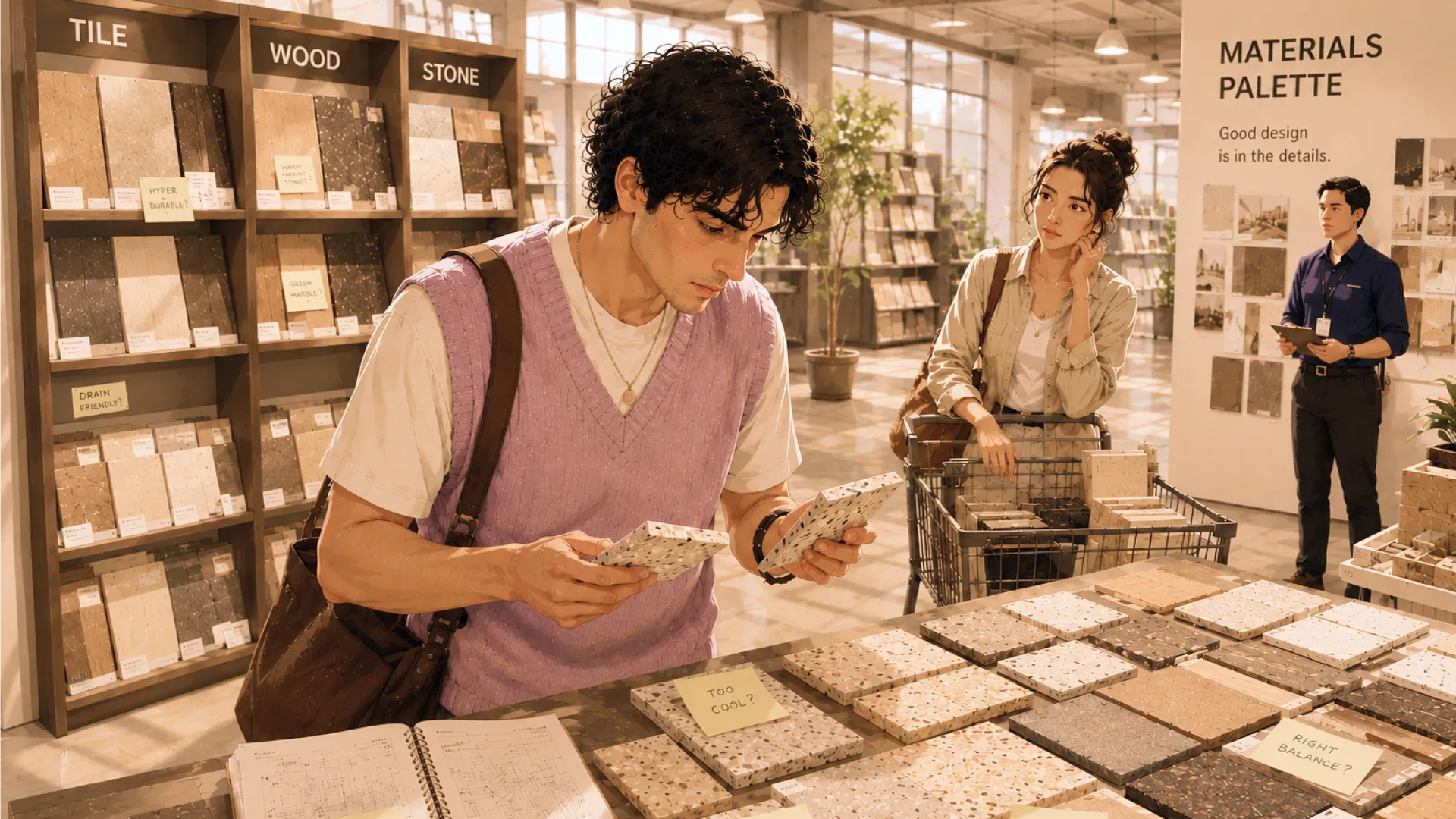
Choosing tiles for a bathroom, you can turn two almost identical samples over for twenty minutes while the person with the trolley waits. The same eye keeps you polishing a piece that already works, and a gift you are making can arrive long after they needed a call.

The Craft comparing tile samples at a materials palette in a showroom, a bag still over one shoulder

Improving what already works

You fix the problem you started with, then notice another detail. Soon you are changing parts that make little difference to the person using it. Each edit feels reasonable on its own, but together they delay the moment when anyone can benefit from the work.

Decide what this version needs to achieve before another round of changes. Does it work reliably? Can someone understand and use it? Is there a remaining problem that matters? When those needs are met, let it be used. Keep less important refinements for a later version, informed by what people actually find difficult.

Decide what this version needs to do before deciding what else to change.

One effort becomes several

When a job with your hands is going well, you carry on with one more load, then another. By the fifth trip up the stairs, you are lifting less carefully than you were. The job is still interesting even though the effort is no longer as controlled as it was at the start.

Pause when technique changes or the same movement becomes noticeably harder. Adjust the load or finish for the day if needed. Your Resilient body does not make repeated strain harmless. Plan the rest between demanding efforts while you still have the choice, rather than treating it as time left over after the work.

Rest is not idleness, and to lie sometimes on the grass under trees on a summer's day, listening to the murmur of the water, or watching the clouds float across the sky, is by no means a waste of time. John Lubbock, The Use of Life, 1894

Redoing their work

Sometimes you redo other people's work and call it helping. A colleague asks you to look over their slides, and you hand them back rebuilt. They wanted a quick check and got their work rewritten. They also notice that you did not ask.

Ask what they want before you touch it: a quick check, three notes or a rebuild. Then point to what felt awkward and let them fix it. Their version will be less polished than yours. It will still be their own work, and next time they will need you less.

Saying that you care

You show care by making something for the people you love. You spend the weekend building them a desk or sewing a quilt for a new baby. It is real care. Sometimes, though, they wanted a phone call on Tuesday, and the desk arrives three weeks late.

Make the quick version as well as the good one. Ring on the day of the hard appointment. Send a photo of the half-built desk so they know it is coming. The big gesture means more when a quick message comes first.

Send the message now. Build the desk later.

Training your body

Your Resilient body and Power energy usually suit strength moves you know well and short, strong efforts, with proper rest between them. A day of making things, carrying boards or moving furniture is part of that load, so plan training around it.

The Craft holding a wide lunge on a yoga mat on a waterside terrace in soft golden light

Warm-up and strength (Physical)

A short warm-up prepares your body for strength work. Warm muscle moves and stretches more easily than cold muscle, and a few minutes of gradual movement gets blood flowing. Warm up before a morning of sawing, digging or lifting too, with an easy version of the moves ahead.

Familiar movements you can control make a good base for strength training. Choose a few that match the jobs you already do, such as lifting from the floor, carrying, pulling and gripping. Repeat them twice a week. Leave a lighter day between sessions, and add a little load once a movement feels comfortable. Pain or tiredness that lasts is a reason to rethink the plan.

Short, strong efforts (Energy)

Your Power setting is likely to suit short, strong efforts, like lifting a heavy box onto a shelf. A warm muscle works faster and with more force than a cold one, so the warm-up is part of the effort itself. After it, try one short effort that matches your fitness.

When a project is going well, you can work through lunch without noticing. Keep water where you work, and stop for a proper meal on long making days. Regular meals are the part that matters.

Rest between efforts until you could repeat the last one just as well. If you cannot repeat it with control, rest longer, make it easier or stop. Keep some longer, easy movement in your week too. A routine you recover from will take you further than doing as much as possible each time.

Rest long enough that your next effort is as good as your first.

Calluses and blisters (Skin)

Skin thickens where it is rubbed again and again, forming a callus. However, thick skin can still blister if the rubbing changes or goes on too long, as with new shoes or a new tool. Protected skin can put up with rough materials, so gloves often stay in the drawer until a long job rubs a blister. Wear gloves for sanding, digging and new tools, and moisturise your hands at night.

Outdoors, use shade, protective clothing and a broad-spectrum sunscreen of SPF 30 or higher, reapplied as directed. Glue, paint, plaster and strong cleaners can still dry out Protected skin, so wash them off soon after a job. If irritation persists or worsens, see a pharmacist or doctor.

Eat after training (Recovery)

After training, a normal meal with carbohydrate and protein does the job. Carbohydrate refills the muscles' fuel, and protein gives them material for repair. A weekend of building, digging or moving furniture is hard training too, so take the next session gently.

Rest works best when it is different from the work. After a day on your feet, sit down. After a day of fussing over details, do something with your hands that does not need to be right, like kneading bread or weeding. Keep the same bedtime, even when a project has you excited.

Count the heavy jobs as training too.

How you think

You think best with something in front of you: a sketch, a model or a first try. Your Intuitive mind often suggests where to start, and making the thing shows you whether that hunch was right.

The Craft looking across a street at a white cathedral, holding a sketchbook with a drawing of its spire, city towers behind

It is by logic that we prove, but by intuition that we discover. Henri Poincaré, Science and Method, 1908

Thinking with your hands

You think better holding something. A problem on a screen stays abstract. Print it, cut it up, pick up the part or sketch the layout, and your mind starts moving. You feel drawn to one corner of it before you can say why.

Treat that first impression as something worth investigating. What did you notice? What would be different if you were right? A small test confirms the useful part or reveals what you overlooked. Take your instinct seriously while still giving it room to change.

Changing one thing

A useful attempt needs a clear question. If you change several things at once, you end up liking the result without knowing what helped. Choose the part you want to understand and keep the other conditions reasonably steady. This makes the comparison easier to learn from.

Set aside about 45 minutes to try a change and review what happened, then take 15 to 20 minutes away if that suits you. Adjust the timing to the task and your attention. Before stopping, write down the change you made and what it did, so the next session starts from the result.

A clear question makes a small test worth doing.

Learning by trying

Instructions on a page can stay vague for you until you try them. Cook the recipe once or build the rough model, and the words start to make sense.

Try one version, notice the result and change one thing. Often the part you expected to matter barely changes the outcome, while a small adjustment does. Reading and instruction still have their place. Experience helps you understand what those instructions mean in use.

Try the idea where you can see what it changes.

Show, then explain

You explain best by showing. Put the thing on the table before you try to put it into words. Point to the awkward movement, compare the shapes or describe the moment something stopped working. A concrete example often explains more than saying it simply feels wrong.

Keep a notebook beside the work, with a line on each change and what it did. Over months, you learn to put words to things you used to judge only by feel. Then other people can use your judgement when you are not in the room.

How you connect

You have a few close friends, and talk comes easiest with them when your hands are busy. You show care with something you made. They still need to hear how you feel in words too.

The Craft arranging daisies and lavender in a vase on a terrace while a friend sits nearby with a cup

Each friend represents a world in us, a world possibly not born until they arrive. Anaïs Nin, The Diary of Anaïs Nin, 1937

Friends you build with

Many of the friends you trust most are people you once made something with: a set for the school play, a garden, a meal for thirty. Working side by side, you talked about things you would never have raised across a table.

Keep finding projects to share with the people you want to stay close to. Cook something difficult together, paint a room or plan a trip. Having a job to do together makes the real conversation easier.

Some friendships grow out of doing a job together.

Praise or notes

You spot flaws at once, even in something a friend is proud of. When they show you a cake they baked, you point out the uneven layer before you know it.

They wanted you to be glad for them. Ask first: “Do you want me to enjoy it, or do you want notes?” Most of the time, the answer is enjoy it. Save the notes for when they ask, and then give only the one that matters most.

Lost in a project

When you are making something, a whole evening can vanish. You look up from the bench or the stove and three hours have gone. To you, it was a good evening. The person at home may have spent it wondering where you went.

Give them a simple explanation. “I am going to lose myself in this for an hour. Come and see it when I am done?” is enough. Then come back at the time you gave, even if the glue is still wet. Predictable contact lets you have space without asking someone else to guess whether the relationship is all right.

Nothing to prove

You enjoy an activity that gives you something to do without asking you to perform. Stirring a sauce, sketching or making a small repair holds your attention comfortably. Your Intuitive mind has room to explore, and nobody needs an immediate explanation. The pleasure is in doing it, even if there is nothing to show afterwards.

Try one of these.

  • Woodworking
  • Cooking
  • Sketching
  • Writing
  • Building something physical

Keep the activity easy enough for the kind of rest you need. Making something is often physical work, and a hobby with a deadline becomes another obligation. You can stop halfway, do something simpler or choose to do nothing. Enjoyment does not need a finished object as proof.

Where you work best

Work rewards you most when you take an idea from a rough sketch to something people use every day. Then you want to watch how they use it. You measure your work by the difference the finished thing makes.

The Craft reading beside a detailed architectural model at an exhibition, visitors browsing behind

Responsibility for the result

You lose interest when your part ends before you can see what happened. You would rather know how the work was used, where it fell short and what could make the next version better. Following it through shows you whether your early judgement was right.

Roles suit you best when you build the first version, watch people use it and fix what they struggle with. That work takes many forms: a product, a service or a piece of communication. What matters is having a clear purpose and a way to judge the outcome. Agree on these early, so your care for quality goes where it is needed.

Good enough by Friday

Deadlines are hard for you. Friday arrives and the piece works but is not yet right. Handing it over feels like signing something you do not believe in, so you ask for another week, or you hand it in and wince every time someone uses it.

Agree at the start what good enough means for this deadline: what must work, what can be rough and what goes in the next version. Write it down. On Friday, judge the piece against that list, and save your own higher standard for the next version.

Agree what good enough means at the start.

Whatever is worth doing at all, is worth doing well. Lord Chesterfield, Letters to His Son, 1746

Teaching the standard

As a leader, you find it easier to correct a piece of work than explain the judgement behind the correction. But if you make every adjustment yourself, others learn to wait for your approval. Show the effect of a change and explain why that effect matters.

Compare an earlier version with a finished one. Identify the few things that made it clearer, more reliable or easier to use. Let the other person try applying the same judgement to a new example. They then work towards a standard they understand, with room for a different method that achieves the same purpose.

Work worth exploring

Many of your best fits involve turning an idea into something people can hold or use. Your interests, experience and qualifications decide which of these suit you, so look at the daily work as well as the title.

  • Design and craft
  • Product development
  • Research
  • Architecture
  • Coaching a skill you have mastered yourself, with suitable training

Look for opportunities to test ideas and improve something people will actually use. The right fit also depends on the pace, working relationships and physical demands. A role that sounds creative sometimes offers little time to develop an idea, while a less obvious field gives you exactly that opportunity.

A life that fits

Build a week that gives physical effort, close relationships and ideas room of their own. Your five settings help you choose what to explore. Your experience tells you which arrangements are actually working.

The Craft in five scenes on a sunlit terrace: carving at a workbench, laying out fabric and tile samples, holding up a cane chair, sketching beside a friend and arranging flowers

Record the load (Physical)

Use your Resilient body as a starting point for regular strength work. Repeat a manageable set of movements and record the load or difficulty. Increase it gradually when technique and recovery support the change.

Include the physical work you already do. If your job or hobby involves lifting, gripping or repeated handling, your training plan should account for it. Consistency is useful when the routine is one your body can recover from.

Repeatable effort (Energy)

Explore your Power energy through short physical efforts appropriate to your fitness, with rest between them. A good session is one where you can repeat the movement with control. More effort is not automatically a better session.

Keep meals, water and recovery easy to fit around activity. Longer, comfortable movement also has a place. Let your actual response help you decide the mix, rather than expecting one energy setting to describe every hour of your day.

Care within reach (Skin)

Keep moisturiser where you will use it, and keep gloves or other protection beside the tools that need them. Your Protected skin usually makes everyday exposure feel comfortable. Regular care still belongs in the routine, including on days when your skin seems entirely fine.

One good conversation (Social)

Your Focused wiring makes one good conversation more appealing than several brief appearances. Arrange time with the people you want to remain close to. Choose a setting where you can listen without also trying to finish something else.

Between visits, let them know you are thinking of them. Send the message when you remember their important day. A small, regular act of contact makes a relationship feel cared for without requiring a long conversation every time.

Testing an impression (Mind)

When your Intuitive mind offers a possible answer, write it down or make a rough version. Decide what would show whether it works. You are making room for the idea while keeping the chance to revise it.

A well-designed week

Physical
Plan two strength sessions on the same few lifts and log the load, counting any lifting your job or hobby already asks of you. On a third day, if your training experience allows, do five or six 15-second efforts on a rowing machine or bike, and end the set when an effort feels weaker than the one before.
Mental
Give one idea two or three sessions this week. In the first, make a rough version quickly. In the next, change one thing and note what it did. Keep small admin for a separate half hour so it stays out of the making time.
Social
Have one proper conversation with someone you want to stay close to, somewhere you can listen without finishing something else. When you remember a friend's important day, message them there and then.
Recovery
Take one day off training and off anything with a deadline. Keep the same sleep hours through the week. If your hands have worked hard, moisturise them at night and wear gloves for rough jobs.
Creative
Give an hour to a small project you are allowed to leave rough, such as a sketch, a loaf of bread or a quick repair. Stop at the first version that works.

Sloth, like rust, consumes faster than labour wears, while the used key is always bright. Benjamin Franklin, The Way to Wealth, 1758

The long game

Over time, familiar practice helps you understand what your body handles comfortably and where it needs more recovery. Your Resilient body and Power energy remain only part of that picture. Training, health, age and everyday demands continue to shape what you can do.

Your Intuitive judgement also develops through experience. You collect examples of what worked, what failed and what surprised you. The useful habit is checking your first feeling against what actually happened. Experience gives you more to recognise, and more reasons to stay curious.

You do not have to make every piece perfect for the work to matter. Finish enough to learn how it works outside your own head. Note what you would keep and what you would change next time, and let that improve the next piece, while leaving time for the people and activities you want the work to support.

Share with someone, and check your match.