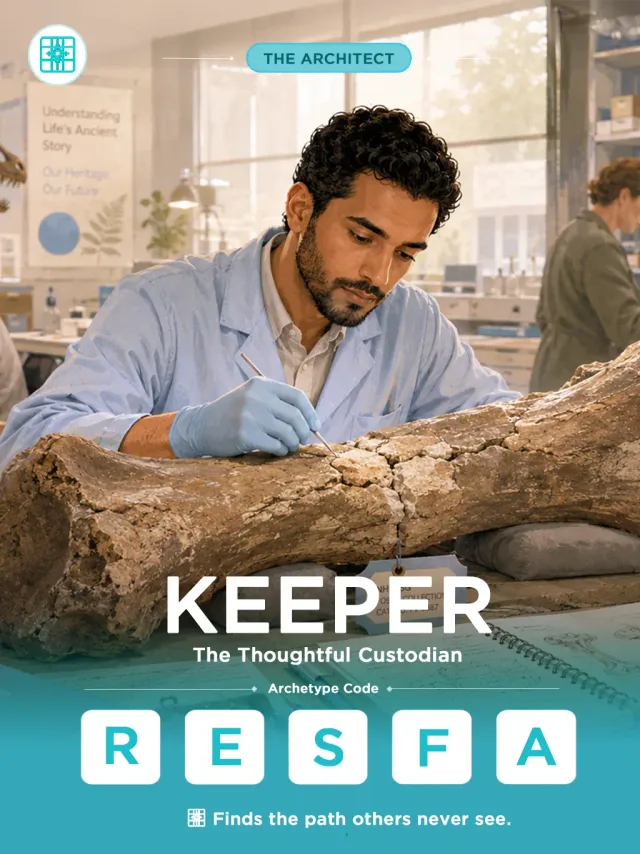
You find a way through when there seems to be none. A company's computer network has grown into a tangle of thousands of links, and the team needs to know if anyone outside could reach the core system. Everyone else is staring at the whole map. You list every rule a path must obey, then trace the one route that fits them all while the others watch it light up.
While you think, it looks as if you have stopped. Then you show the route, and nobody remembers why it seemed hard. A needle slips through thick cloth by finding the gaps between the threads, and you get through a crowded problem the same way.
Some of this is learned. Some of it is biology, and that part has a name.
Yours is called The Needle.
The short version
You treat a hard problem as a list of limits, and look for the one plan that fits them all. You check where each option leads before you commit. What you need is a way through. What you fear is being forced to choose before you have found one.
You see, but you do not observe. Arthur Conan Doyle, A Scandal in Bohemia, 1891
Why DNA?
Think of DNA as a set of biological instructions written before you were born.
Your DNA does more than set your eye colour or height. Your genes also influence how your muscles are built, how your body produces energy, how your skin protects itself and how your brain processes information. Together, these biological settings help shape your DNA-Archetype.
They do not dictate your personality or your choices, but they can influence how your body naturally responds. Some things you have always thought of as ‘just me’ may have a biological layer too.
These are your factory settings. You did not choose them, but once you know them you can design around them.
The five settings that make you The Needle are: Adaptive Body, Power Energy, Sensitive Skin, Focused Social Wiring, and Analytical Mind.
02 Your Genetic Build
Your five settings
Five settings make you The Needle. Each one explains a different part of how you naturally operate.
Physical A
Adaptive
Your genes help shape the muscles and connective tissues you use to move. Strength, the force your muscles can produce, is one of the traits they influence. With an Adaptive tendency, you may feel comfortable changing how you move to meet a different physical demand. You change the angle, shift the load and find a position that works.
You may notice this when carrying something awkward or finding your footing on uneven ground. A small adjustment can make the movement feel easier.
You do not need to repeat a movement in exactly the same way for it to feel right. What matters is finding a way your body can manage in the conditions it actually has.
Energy P
Power
Your metabolic genes help shape how your body makes energy available. Power describes a tendency towards short, forceful effort. Think of a flare. It burns brightly for a moment, without needing to give a steady light for hours.
You may recognise the appeal of a quick acceleration, a jump or a brief, demanding effort. For that moment, you can put a lot into the movement.
Then the demand changes. Your body needs time before another hard attempt. How quickly you recover after exercise is one of the traits your genes influence, which is why that pause matters. Needing that pause does not take away from the effort you just made. It is part of being ready to produce it again.
Skin S
Sensitive
Your genes help shape how your skin holds moisture and responds to its surroundings. How skin copes with sun, and how it changes with age, are partly inherited as well. A Sensitive tendency means everyday contact may be more noticeable to you. A rough seam, a new product or dry air can leave your skin feeling uncomfortable.
You may know exactly which collar is bothering you while no one else can see a problem. The feeling can be clear even when the change is not visible.
That is why a small choice of fabric or product can make a real difference to your day. You are responding to something you can feel. Over time, you may become quite specific about what your skin is comfortable with.
Social F
Focused
Your genes play a part in the brain systems involved in social connection, alongside your experiences. Researchers find that traits such as empathy and the enjoyment of company are partly inherited. A Focused tendency describes feeling most invested in a small number of close relationships. You may be perfectly capable of meeting lots of people and still come away feeling that only a few connections really stayed with you.
A handful of relationships may carry far more weight than the size of your social circle suggests. With those people, ordinary time together can feel enough.
You may take time to let someone close. Once you do, meeting someone new does not make the existing relationship matter less. You value what has had time to grow.
Mind A
Analytical
Your genes contribute to how your brain develops, while learning and experience shape how you reason. Traits such as concentration and how you respond to stress are partly inherited. You may be more comfortable with an answer once you can see how it was reached. Your mind builds understanding step by step.
If one part does not make sense, moving on rarely makes the question disappear. A conclusion can still feel unfinished if you cannot trace how someone got there. “Just trust me” is rarely enough. You want to see the logic.
When something turns out to be wrong, you can often go back through the reasoning, find the step that failed and fix it there instead of starting again.
03 Natural Strengths
What you do well
Your strengths show when there is very little room for error. At full draw on an archery field, you take in the wind, the distance and your own tired arm, then make the one shot that fits them all.
Small corrections
Your Adaptive body can give you room to change your position as a movement goes on. In any skill you practise, you learn how a small change in grip or stance moves the result. Wind, distance and a tired arm are simply more limits, and you correct for each one.
The useful skill is noticing which adjustment helps. Once you can repeat it, you have something more dependable than one lucky result. Practice lets you carry that understanding into slightly different conditions.
Every condition is one more limit to plan around.
Planning for one try
Your Power energy can give you one strong burst, and a burst cannot be repeated straight away. So you plan for one try. You check your footing, the distance and what could go wrong, then go.
The satisfaction is in doing one difficult thing cleanly. The attempt feels controlled, and the result gives you something specific to learn from. You can tell which part to keep and which part needs another adjustment.
It is with a pattern as with a fortress, it is no stronger than its weakest point. William Morris, Hopes and Fears for Art, 1882
Meeting every limit
You look for a plan that breaks none of the limits. The budget is fixed, the venue is booked and two speakers cannot share a stage. Other people pick the limit they can live with breaking. You write all three down and look for the order that breaks none.
Most of the time one exists. It is narrow, and it means doing things in an unexpected order: the second speaker first, the room for two hours instead of a day. Once you show it, people wonder why nobody saw it.
Write every limit down before you choose a plan.
At ease with uncertainty
You can live with an unclear answer for a long time, provided each check rules out one more path. Uncertainty bothers you far less than a dead end.
You keep going after others have called it a dead end. When one rule seems to block every plan, you check whether it is really fixed. Often it turns out to be a habit nobody questioned, and the way through opens.
04 Friction Points
Where it costs you
Your talent for finding a way round things has costs. You go round people you should talk to, you dig in when pushed to choose, and when everything demands attention at once, you can find no way through at all.
He says the best way out is always through. Robert Frost, A Servant to Servants, 1914
Going round people
You would rather find a clever route round a difficult person than talk to them. You move the meeting, get the approval elsewhere and rebuild the plan so you never need their agreement.
It works for a while. Then the person notices they have been left out, and they may stop helping you at all. Have the awkward conversation before you start planning a way round them.
Some problems only need one honest conversation.
Pressed to decide early
Being cornered is the feeling you like least. Someone says “Pick one of these two by five”, and you can see a third route but have not tested it. You go quiet or dig in, and look stubborn.
Say the third route out loud, untested, and ask for an hour. If there is no hour, pick the better of the two and note the other path for next time. A choice made under pressure can still be a good one.
Keeping every option open
Because a way through matters so much to you, you hate closing one off. You keep two job offers alive, three holiday plans and a backup for the backup. Each open option takes a little attention every day.
Give each open option a closing date. When the date comes, choose, and tell the people waiting on your answer. Once you have let an option go, it stops using up your attention.
Give every open option a closing date.
When everything is urgent
Your method needs a clear list of limits, and it stalls when everything arrives at once. Messages, alerts and requests pile up, each one marked urgent, and there is no order left to find. You freeze, and people read it as panic.
Treat the pile as one more problem with limits. Ask which item truly cannot wait, deal with that first, and pause everything else for an hour. The rest will still be there, and it will look smaller.
05 Body Optimisation
Training your body
Your Adaptive body is likely to enjoy learning a new move until it runs cleanly, and short, sharp efforts can suit your Power setting. Kit that stays against your Sensitive skin, such as hand wraps and gloves, needs some thought too.
Learning new moves (Physical)
A new movement feels clumsy at first, because the brain has not built the pattern yet. With practice the pattern forms and the movement smooths out, at any age. Your Adaptive setting can make that clumsy stage enjoyable, because each miss shows you one more thing to correct.
Depending on your experience and interests, try bag or pad work with a good coach, or a racket sport or team game, starting gently.
Balance and footwork exercises and controlled changes of direction help too. Add a second activity that uses different movement skills.
Start with easy movement and a few practice attempts before adding speed or load. Early misses are part of learning, so adjust the session to how you feel today.
Let the first few attempts help you choose the right level for today.
Burn and soreness (Energy)
Short, demanding efforts, like a hard round on a punchbag or a sprint for a bus, often suit your Power setting.
The burn during a hard effort comes from chemical changes in the working muscle. It clears within minutes, while next-day soreness is the muscle repairing small strains. Rest between hard attempts, and ease off if you lose control of the movement.
Plan food as you plan anything, working back from the session: a meal a few hours ahead, a snack if it is late, a proper meal after.
Fragrance-free basics (Skin)
Your Sensitive skin often does best with a mild cleanser and a moisturiser without fragrance. The skin's surface is naturally slightly acidic, which helps it protect itself. Harsh soaps can upset that balance, which is why gentle cleansers suit skin that reacts easily.
Avoid new products while your skin is irritated. Outdoors, use shade, protective clothing and a broad-spectrum sunscreen of SPF 30 or higher, reapplied as directed. If irritation persists or worsens, see a pharmacist or doctor.
Sweat builds up under hand wraps and gloves. Wash the wraps after each use, let gloves dry out fully, and stop any new product that brings on a rash.
Sleep after training (Recovery)
Hard efforts and new movements both need recovery, so lingering soreness or poorer control calls for an easier next session.
Space out your hardest sessions, and leave one full day each week with no hard training. A warm shower or bath an hour or two before bed can help sleep. The body cools afterwards, and cooling is a signal for sleep.
Rest is one more limit, so plan around it like the others.
Gentle movement, a quiet evening or an earlier night all count as recovery.
06 Mind & Cognition
How you think
Before discussing solutions, you want to see every constraint at once. You think in routes: where each path starts, what it must avoid and where it has to end.
We are by nature observers, and thereby learners. Ralph Waldo Emerson, Essays: First Series, 1841
Weighing the constraints
You write every constraint on one page before you look for an answer: the fixed date, the person who cannot travel, the budget line nobody can move. Seen together, they often leave only one or two options.
Then you test those options from both ends. Work backwards from where the plan must finish and forwards from where it starts. Where the two meet is usually your answer.
Work backwards from the finish as well as forwards.
Draft after draft
You work a plan out on paper, and rarely in one go. You sketch one order of steps, find the limit it breaks and start again. By the tenth draft, the plan that fits every limit is on the page.
Keep the failed drafts. Showing people the three that broke a limit explains your quiet better than any update, and shows them why the last one works.
Each draft that fails shows you one more limit.
Doubts as questions
Sometimes a plan looks right and something about it still bothers you. Often it breaks a limit nobody wrote down: a school run, a lease date, a person who was never asked. Your strength is turning that unease into a question you can test.
Ask what the plan assumes, and check each assumption against your list of limits. The one that does not fit is where to look first. You do not need the answer yet, only the place to start.
A ten-minute version
Sometimes there is no afternoon to find the way through. The call is in ten minutes and a choice is due. A short version of your method still works, and it means you are not forced into someone else's choice.
In ten minutes, do this.
Write the three constraints that cannot move
Cross out every option that breaks one
Pick the remaining option with the most room to spare
Note what you would test with another day
A rough plan of your own is better than being handed someone else's.
07 Relationship Wiring
How you connect
You get close to people side by side, with your hands busy. Cooking together after a long week, you talk more freely than you would across a table, and you notice the moment the other person goes quiet.
My Friend is that one whom I can associate with my choicest thought. Henry David Thoreau, A Week on the Concord and Merrimack Rivers, 1849
Knowing their limits
You learn the limits of the people close to you the way you learn a problem's. One friend cannot do late nights, another is short of money this year, another hates crowds. You plan around all of it without being asked.
People feel looked after, often without knowing why. However, if you never say it aloud, they cannot tell you when a limit has changed. Ask now and then what is different this year.
Finding time together
Two people with full lives often decide they cannot meet. You lay both weeks side by side and find the gap: forty minutes between their dentist appointment and your train, a coffee at the station. For someone you love, a hard diary is a puzzle worth solving.
Ask before you rearrange their week as well as yours. “I found forty minutes on Thursday. Want them?” leaves them free to say no. A tight plan that suits you can feel like too much for them.
Forty minutes this week is better than an evening postponed.
Big shared decisions
At home this shows most in big shared choices: a move, a holiday, a new job for one of you. You want every limit on the table before you choose, and the other person may want to pick tonight.
Share the list you are working from as you go. The other person can see the choice moving, add a limit you missed and help you find the plan together.
Avoiding hard subjects
The habit of going round things turns up at home too. Instead of raising a hard subject, you arrange life so it never comes up. That can run for years.
Some signs you are doing it:
Plans always made so one person is not there
A topic you steer away from within a sentence
A chore you took over to avoid discussing it
A message drafted three times and never sent
Relief when the other person cancels
Pick one and raise it directly for once. Raise the subject early in the evening, somewhere you can both walk. It usually takes less time than avoiding it has.
08 Career Performance
Where you work best
Your best work comes when a plan has to satisfy many people and many rules, such as a network that thousands rely on, and someone has to find the one route that does. You do well where you are trusted to find it and then show the room why it works.
Where you excel
You are good at jobs that look impossible on paper. A project with a fixed date, a fixed budget and an inspector watching defeats most planners. You find the order of work that satisfies all three and explain, step by step, why it holds.
Your Adaptive body may also suit practical work that needs controlled adjustment, from handling materials to learning a precise movement. Interest, training and experience decide which skills you develop. The useful career question is whether you enjoy the daily work of becoming good at them.
The supply of time, though gloriously regular, is cruelly restricted. Arnold Bennett, How to Live on 24 Hours a Day, 1908
Conditions for good work
Look for work where the constraints are real and stated. Vague rules are hard to plan around, because nobody can tell you where the limits are. Ask early what cannot move.
Sudden decisions with no warning are what you find hardest. Agree how much notice choices will usually come with, and say early when one is coming too fast for you to find a good option.
Make progress visible during investigations. Share the question you are testing, what you have ruled out and when a decision is due. This helps colleagues understand the work and gives them a chance to tell you if the priority has changed.
Name the question you are testing, so people can see your progress.
Leadership signature
You lead by putting the limits where everyone can see them. Once a team knows what cannot move, it stops arguing about what it wants and starts finding what will work. You slow a hasty decision and help people tell evidence from guesswork.
Show the team how you found the answer, dead ends included, and they start finding answers of their own. Ask what they notice before sharing your conclusion. Next time the limits pile up, someone else may find the way through first.
Roles worth exploring
These roles reward finding one way through many fixed rules. Your interests, experience and qualifications decide which of these suit you, so look at the daily work as well as the title.
Clinical work that requires careful observation and technical skill
Technical engineering and troubleshooting
Software architecture and systems design
Diagnostic and investigative work
Planning and evaluating targeted interventions
Research and evidence analysis
Precision craftsmanship
09 Live By Design
A life that fits
A useful week gives your body enough movement and recovery, your skin consistent care, and your important work enough uninterrupted time. Start with a few changes you can sustain, then adjust from experience.
One main activity (Physical)
For your Adaptive body, choose one main activity to practise regularly and a second that asks something different of you. You might combine strength training with dance or climbing with balance exercises. Familiar practice and manageable variety work together.
Begin sessions at an easier level. Notice how you are moving before adding difficulty, and leave with something specific to practise next time. Progress is easier to recognise when every session does not have to prove your ability.
Planning hard efforts (Energy)
Give Power efforts a place in the week when you can arrive reasonably rested and recover afterwards. Avoid treating every workout as a maximum effort. Adjust the amount if demanding work, poor sleep or other commitments have reduced what you can comfortably manage.
Keep regular meals and fluids within reach on busy days. If a session repeatedly leaves you depleted, review its difficulty, your recovery and how you are fuelling it. Your day should help support the activity you chose.
Fewer irritations (Skin)
Check the skin under gloves, straps or tight kit after each session, and deal with a rub on the day it appears rather than a week later.
After you swap a product or a piece of kit, notice what improves and what does not. When a piece of kit or a cream suits your Sensitive skin, it tends to keep suiting it, so keep it and stop testing.
Your chosen people (Social)
Your Focused social wiring tends to do best when time with people has a set place in your week. Arrange time with someone you want to see, and leave enough space to enjoy it without watching the clock throughout.
Choose somewhere you can sit comfortably for a while. A loud room or a hard chair cuts a good conversation short before it gets anywhere.
Set thinking time (Mind)
Reserve time for questions that need your Analytical attention. Start by writing what you are trying to decide. Finish by noting the conclusion or the next check. That gives the session a useful result even when the whole problem is not solved.
When someone else will use the answer, include the reason for it. A few clear sentences about the evidence, the recommendation and any remaining uncertainty are enough. You do not have to reproduce every thought you had.
A well-designed week
Physical
Choose one main activity to practise, such as dance, climbing or a racket sport, plus one strength session. Begin each with ten minutes at an easy level. If your training experience allows, add a short power set once a week: four to six jumps, throws or sprints of a few seconds each, with a full rest after every one.
Mental
Reserve two blocks for work that needs precision. Write the decision you are making at the top of the page, and stop when you have either a conclusion or a named next check. Leave the rest for tomorrow.
Social
See someone you have been meaning to see, somewhere you both find easy. Put one message you owe someone into a reminder with a date on it.
Recovery
Hold the same bedtime on most nights, and give one day a rest from demanding training. Keep a second pair of training gloves or socks, so a damp pair never goes back on.
Creative
Spend an hour on something that rewards a precise hand, such as sewing on a button properly, icing a cake or tying a fishing fly. Let the result stay imperfect.
The great thing, then, in all education, is to make our nervous system our ally instead of our enemy. William James, The Principles of Psychology, 1890
The long game
Over the years you collect answers that worked. Clashing diaries, a budget that will not stretch, two people who cannot share a room: you have found a way through each before. A new problem often has an old answer, once you check what is different this time.
Your movement skills develop through practice too. Your Adaptive body has more familiar adjustments to draw on as you learn. An activity you once found awkward becomes enjoyable when the basic movements no longer require all your attention.
You also learn what helps your Sensitive skin stay comfortable, how much demanding activity you recover from well, and which commitments you want to protect. Biological tendencies become more useful when you understand how they show up in your own life.
The aim is to trust your observations enough to investigate, and your judgement enough to stop when the answer is useful.
You do not have to force your way through every difficult thing. Looking closely reveals a route you did not see at first. With practice, you learn which details deserve more attention and when you know enough to take the next step.