DNA Stories Living with Genes

The Genetic Symphony Between Chromosomes, Genes, And DNA

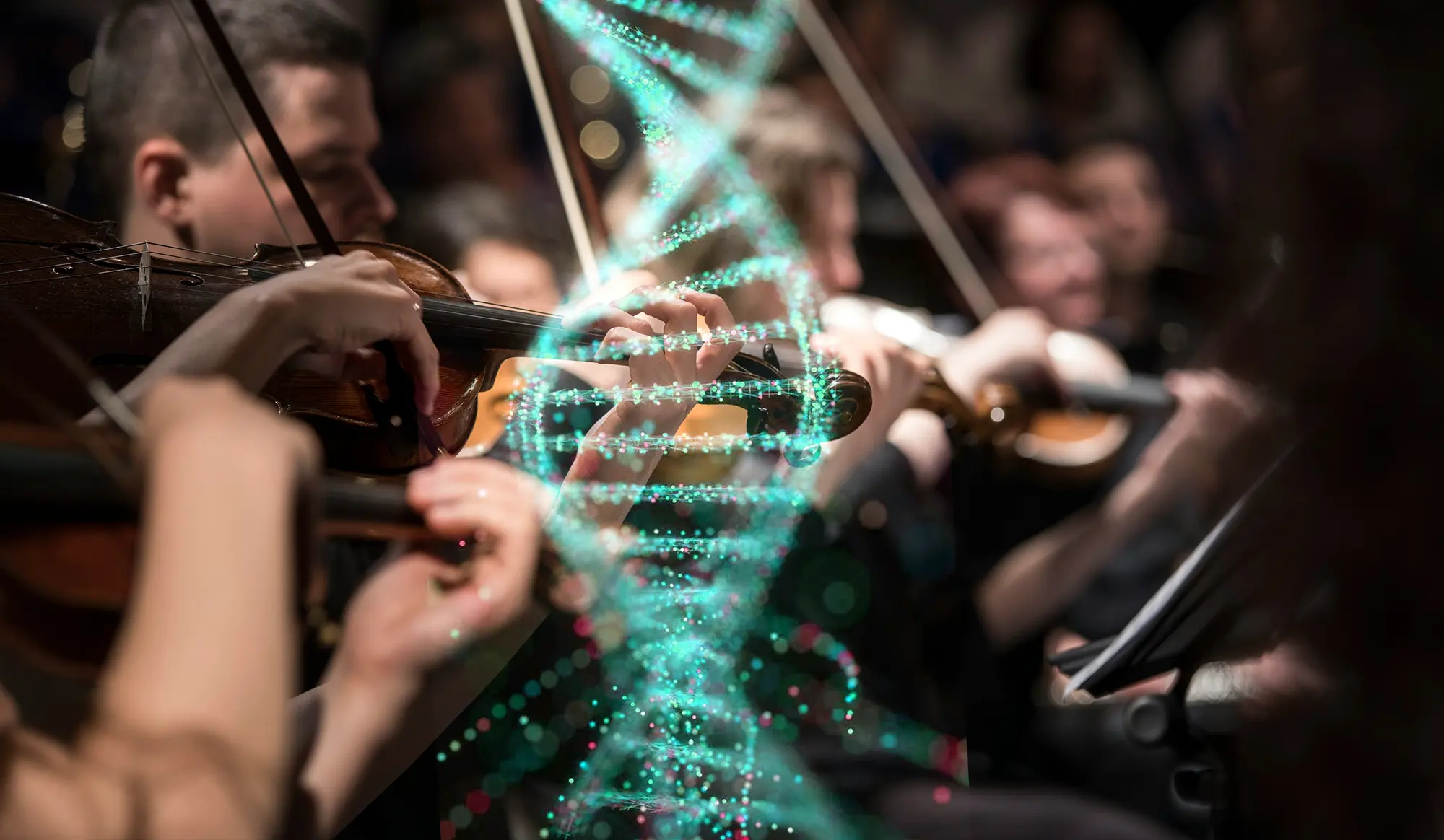
What do music and DNA have in common? If they aren't composed properly, you won't enjoy your life.

Cedric Lee

Founder and CEO, ConnectingDNA · · 6 min read

Editor's note. This issue first ran in December 2023 and keeps the voice it was written in. We are more careful today about what a DNA test can tell you, and What your DNA can and cannot tell you sets out where we stand.

In the intricate melody of life, our genetic code plays an important role in ensuring our biological symphony is orchestrated properly.

A good composition ensures a strong and healthy life. A bad composition creates genetic mutations and a life of sickness and pain.

At the heart of this lie 3 essential components: chromosomes, genes, and DNA. While many people may be familiar with them, not everyone understands the differences between these 3 elements. In fact, many mistakenly assume that genes and DNA actually mean the same thing. They do not.
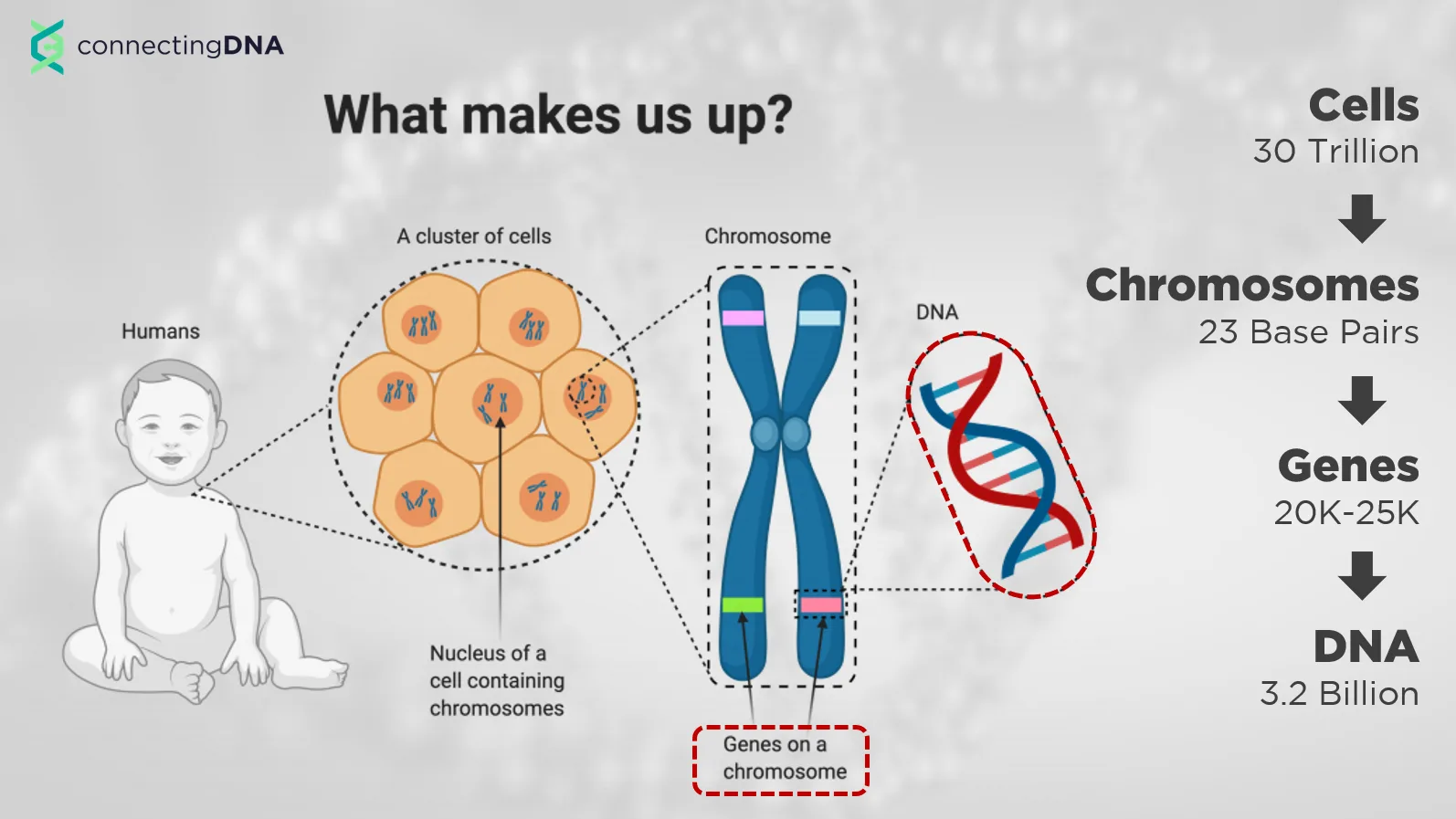
A diagram nesting cells, chromosomes, genes and DNA inside one another, with the count of each
Many people do not know this, but chromosomes, genes and DNA are just "subsets" of each other. Extracted from my seminar deck titled "Impact of Genetics".

In this article, let us explore the fascinating world of chromosomes, genes, and DNA in the perspective of a grand orchestra. We will uncover the nature of each element, as well as their unique roles that make up the wonderful performance called “Life”.

What Separates Genes From DNA?

Genes and DNA are not the same thing, though most of us use the words as if they were. DNA is the material, genes are the instructions written in it, and chromosomes are the packages that hold them.

Imagine if our genetic material is a grand orchestra, each section representing a vital component of our biological makeup. The entire symphony is composed of 4 major parts: Nucleus, Chromosomes, Genes, and DNA.

Nucleus: The Symphony Concert Hall

The cell nucleus is like a grand concert hall, the central stage where the entire performance unfolds. It is enveloped by a strong double membrane, ensuring that the delicate proceedings inside are protected and regulated.
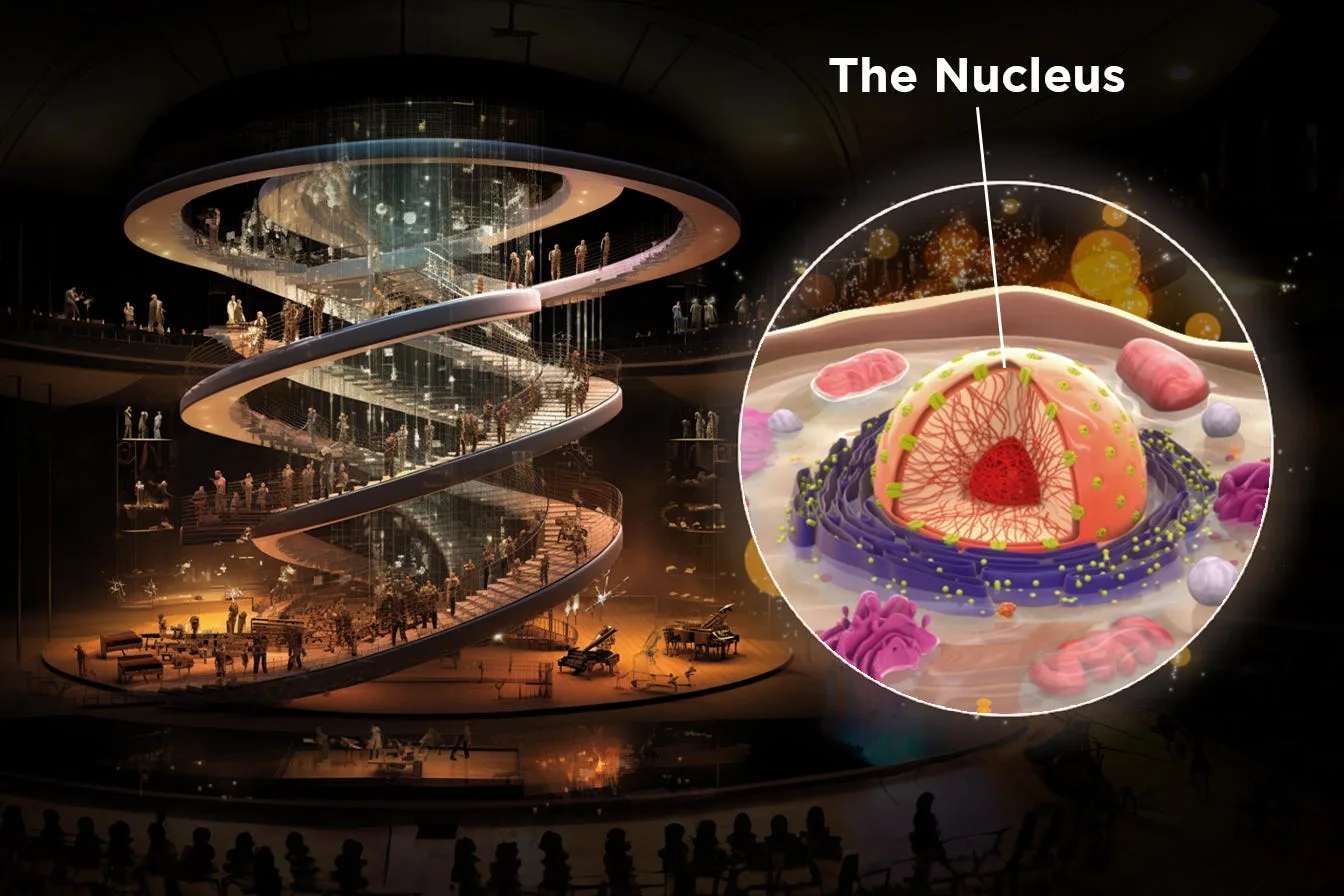
A spiral concert hall with a cell nucleus drawn in a circle beside it
The nucleus is located in the centre of your cells and is where your genetic information is stored. Image generated by Midjourney AI and edited in Photoshop.

Apart from that, the nucleus also plays the role of a conductor, orchestrating our separate genetic components into a beautiful song.

Indeed, much like how an expert composer directs different parts of the orchestra to create beautiful music, our nucleus dictates when (and where) specific genetic expressions occur, synchronising the timing and sequence of these events with precision.

Chromosomes: The Master Musicians

Now, envision chromosomes as talented musicians in the grand hall. Each of us have 46 musicians, organised into 23 pairs. Imagine each pair has different instruments, and is tasked with playing a specific role in the orchestra, creating unique structural proteins that form our body (and personality).
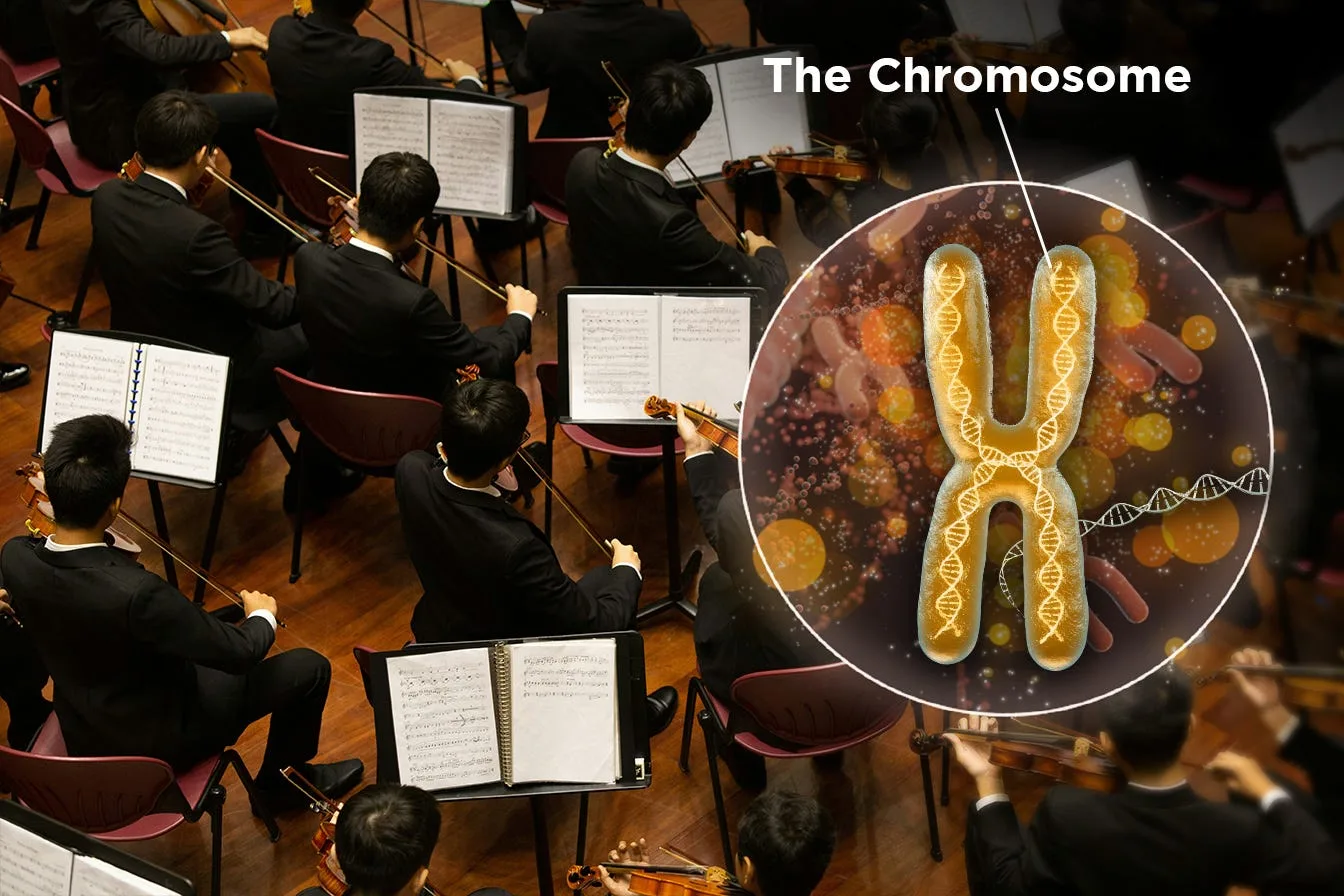
An orchestra seen from behind, with a chromosome drawn in a circle beside it
The chromosomes are located inside your nucleus and each pair of chromosomes have specific roles to play. Photo credit from Unsplash, and edited in Photoshop.

However, out of the 23 pairs, there is 1 pair that is “odd”. Unlike the rest of our 22 pairs which are essentially twins (called Autosomes), that last pair of our chromosomal assembly can sometimes be different. They are called Sex Chromosomes.

For roughly 50% of the population, that pair is made up of Ms X and Ms X (twins), and a female is born. However, when one of the Ms Xs is replaced by a “Mr Y”, the entire symphony gives birth to a male biology.
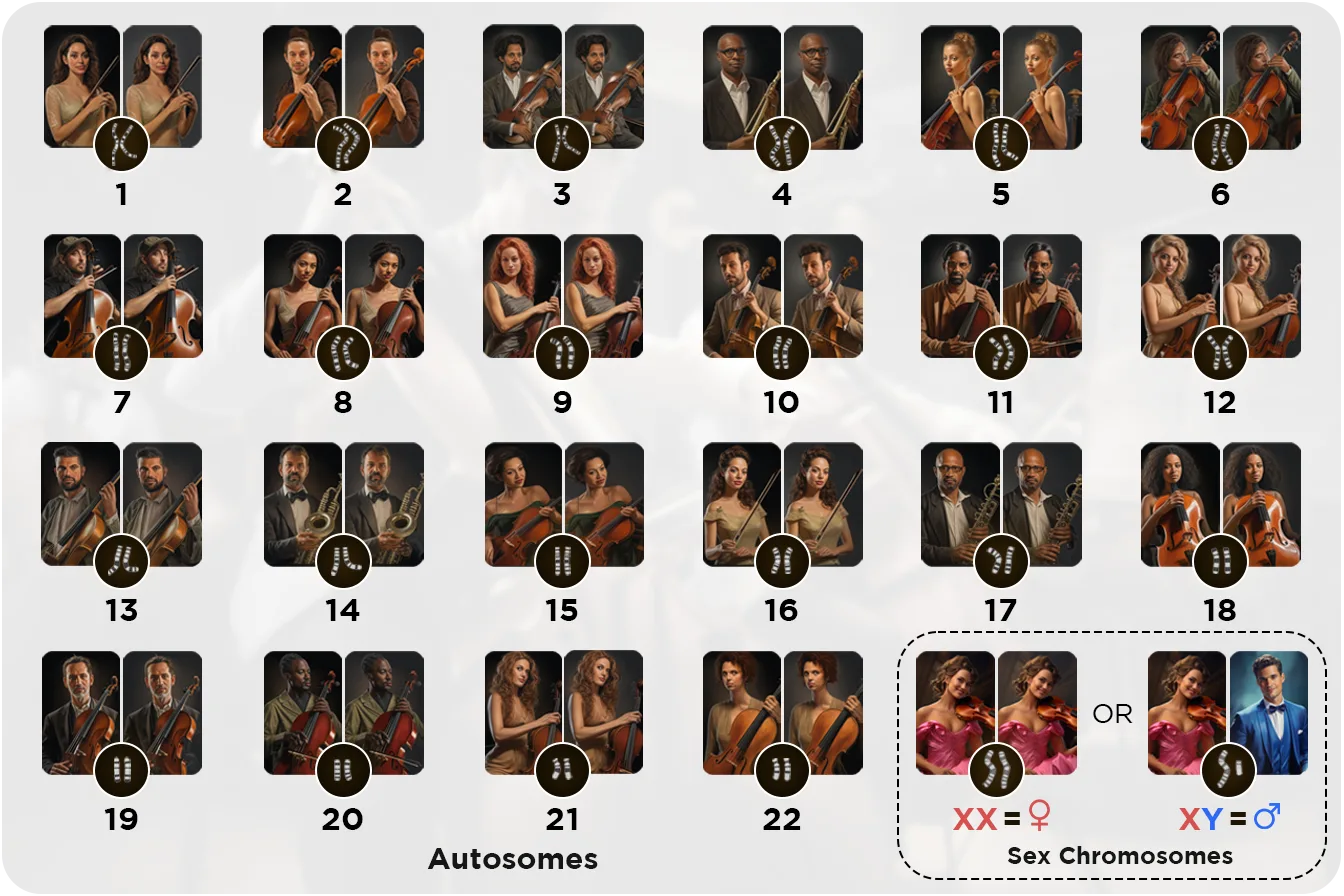
The 23 chromosome pairs drawn as 23 pairs of orchestra players, with the sex chromosomes boxed at the end
Our chromosomes dictate our physical attributes and gender. Image generated by Midjourney AI and edited in Photoshop.

Genes: The Musical Compositions

With each chromosome (musician), we find the genes, the musical compositions that allow our genetic performers to play beautiful music with their instruments.
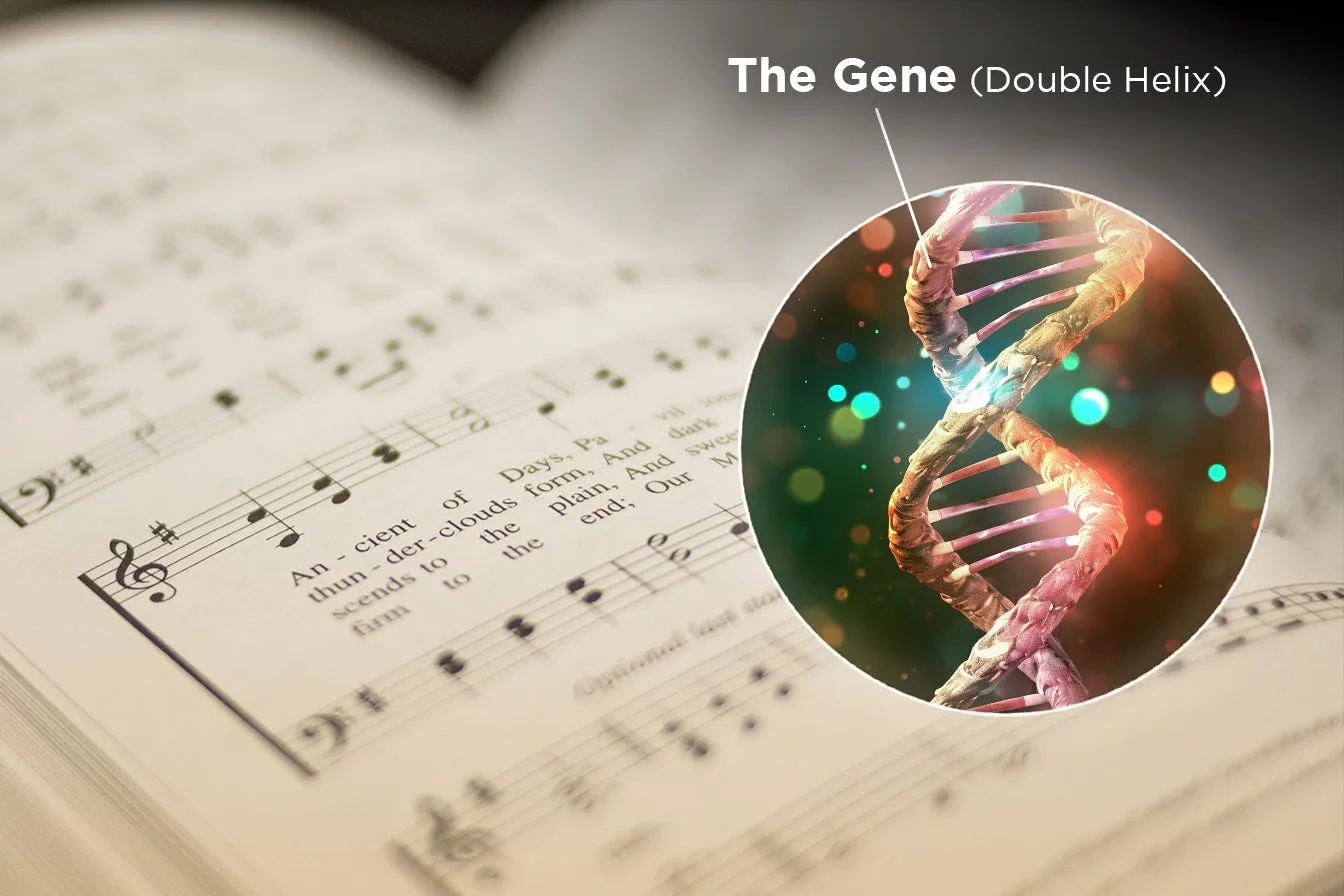
An open book of sheet music with a double helix drawn in a circle above it
Genes are double-helix structures containing your genetic codes. Genes that are tightly packed together become your chromosomes. Photo credit from Unsplash, and edited in Photoshop.

Whether the composition is for the epic Star Wars theme song (yes, I am a Star Wars fan!), or the catchy tune of “Flowers” by Miley Cyrus, each piece instructs the timing and flow of music for our chromosomal pairs. For example, in Star Wars, the composition dictates when the flutes should be played and when the trumpets should come in.

Just as different musical pieces contribute to the overall beauty of a concert, genes hold the instructions for creating synergistic proteins, our building blocks of life, that determine various aspects of our health and body.

DNA: The Musical Sheets

Lastly, at the heart of it all is our “DNA” (or deoxyribonucleic acids). DNA is made up of molecules called Nucleotides, and these nucleotides are like the various music notes that make up a musical chord.

Our musical chord is comprised of a combination of 4 different types of nucleotides. They are Guanine, Adenine, Cytosine and Thymine. The unique combination of these 4 molecules make up the intricate and precise music sheets that contain the notes and instructions for each musical composition.
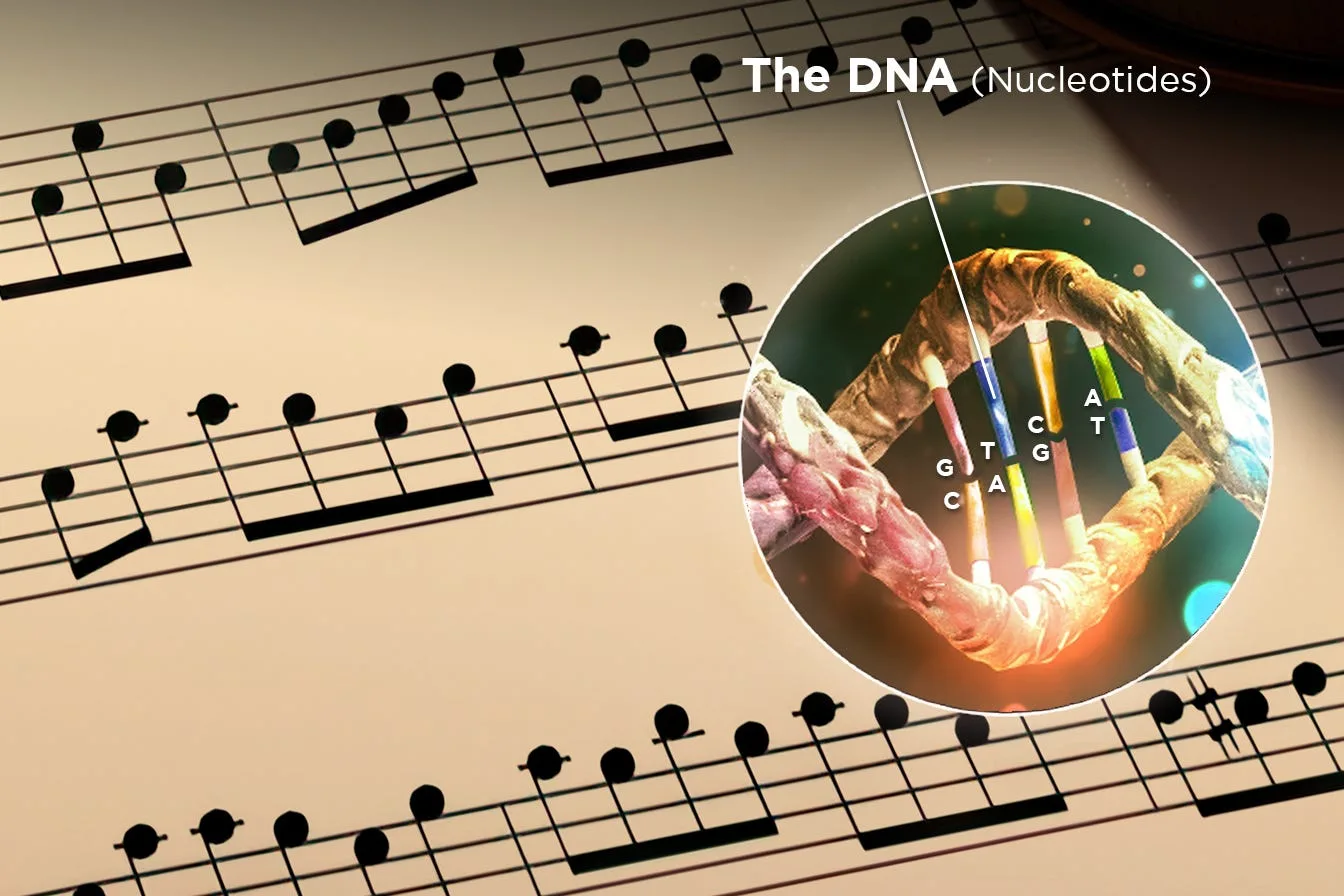
A stave of musical notes with the four DNA nucleotides drawn in a circle over it
DNA is comprised of 4-nucleotide combinations. Within a single tetranucleotide block, there can be 256 possible combinations of different and repeating patterns.

Indeed, our DNA is the blueprint that guides the creation of proteins and, consequently, shapes our physiological characteristics. Every twist and turn in the DNA sequence creates an important note in the grand symphony of our life.

The Choreography of Genetic Expressions

This interplay of elements results in the formation of our unique genetic expressions and biology.

Picture it as a live performance where the grand concert hall (nucleus) holds the musicians (chromosomes) to play specific composition pieces (genes) using the meticulously crafted music sheets (DNA). It is this combination of elements that determines the melody of our existence.

Furthermore, during the symphony of life, genes can be “turned on” or “off” based on various external factors. It is similar to how a single musician may play a wrong note and ruin the entire song (for example, a genetic mutation leading to cancer), or a foreign intruder (a virus) can crash the concert, disrupting our performance of life.
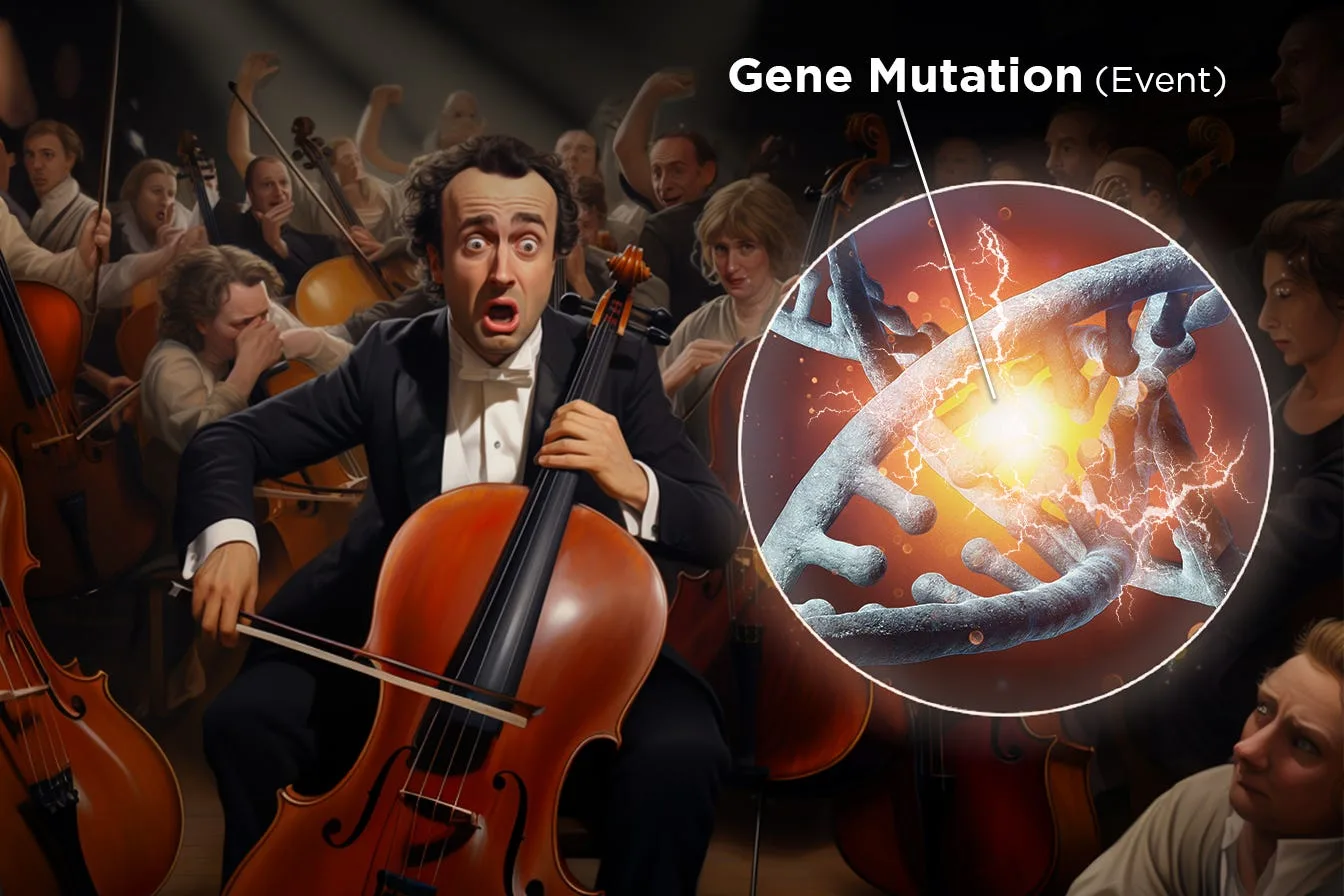
A cellist playing a wrong note in alarm, with a broken helix drawn in a circle beside him
When genes are composed and "played" wrongly, irregular events like mutations may occur. Image generated by Midjourney AI and edited in Photoshop.

Indeed, besides our gene expressions, we must also consider the impact of environment and lifestyle on our genetics.

Conclusion

Beyond understanding the profound relationship between chromosomes, genes, and DNA, it is also an invitation to embark on your personal journey of self-discovery, and unlock the mysteries encoded in your genetic “score”.

Through modern marvels like DNA testing, we have the opportunity to unravel the musical notes that make up the unique melody of our existence.

As the symphony of life is always dynamic, and ever-evolving, let the notes of your genetic code guide you on a journey of self-discovery, and may the revelations that unfold inspire you to embrace the beauty and diversity that is encoded within you!

Sources

  1. How many chromosomes do people have? (MedlinePlus, 2021)
  2. Translation: DNA to mRNA to Protein (Nature Education, 2008)
  3. Deoxyribonucleic Acid (DNA) Fact Sheet (National Human Genome Research Institute)
  4. Mutation (National Human Genome Research Institute)

If you want to read your own score rather than the general one, the Bio-Profile is where the notes become sentences.

Cedric Lee

Cedric Lee

Founder and CEO, ConnectingDNA

Cedric has spent over twenty years in healthcare, wellness and technology, and has taken his own DNA test with more consumer labs than he cares to admit. He writes the Living with Genes newsletter and founded ConnectingDNA to turn genetic reports into something a person can act on.

Connect on LinkedIn ↗

First published on Living with Genes, Issue 9. Rewritten and brought up to date for this site.

Know someone who should read this?

Keep reading

All stories →

What your DNA can and cannot tell you

A short, honest list of what a wellness test can and cannot do.

5 Aug 2026 · 4 min read

DNA-Archetypes: the profiler for your body

Four-letter tests give you 16 types. Adding the body makes 32.
18 Jun 2026 · 5 min read

Your Genes Might Make You Secretly Heroic And Selfless

Heroes may not just be the stuff of legends. In fact, the potential for heroism and selflessness may lie hidden within us.

12 Feb 2024 · 6 min read

Get Cheat Codes To Aging And Longevity By Using Your Genes!

Everybody have a biological clock counting down to the end. What if we can slow down, or even reset that clock?

18 Dec 2023 · 7 min read

Are Insurance Companies Using Your Genetic Data?

Well, they probably are, but NOT in the way you think.

25 Nov 2023 · 7 min read

DNA Testing VS Health Screening Checkup: A Pilot's Perspective

Like water and oil: they flow the same, yet are totally different.

20 Nov 2023 · 5 min read

5 Reasons To Consider A DNA Test: Unlock Your Potential!

Knowing yourself inside-out helps you appreciate life more.

13 Nov 2023 · 7 min read

Giving Our Children A Brighter Future. From Genes To Geniuses!

Raising kids is hard. But if we know our child's natural talents and traits, things might get a lot clearer, and easier.

6 Nov 2023 · 5 min read

Your Genes Have An Impact, It's A Multiplier!

Don't let your genes control you. Learn to control them!

24 Oct 2023 · 8 min read

7 Reasons Why Your DNA Report May Feel Inaccurate!

Most DNA reports are quite accurate, but things can sometimes get weird.

16 Oct 2023 · 9 min read

Consumer VS Medical DNA Testing: Unveiling Your Genetic Code!

Helping you dissect the best options you can have for your precious saliva sample.

9 Oct 2023 · 5 min read

Why you shouldn't upload your DNA report to ChatGPT

The same applies to Claude, Gemini and other public AI.

26 Sept 2026 · 6 min read

I have a DNA report. So what?

You read your DNA report once, then forgot it. Here is what it is for.

9 Jul 2026 · 7 min read

Cedric Lee's third year as top Genetics Influencer

Three years first in Singapore. Now third in the world.

23 Jun 2026 · 2 min read

ConnectingDNA awarded ISO 27001 certification

Independent proof that your DNA data is kept safe.

7 Apr 2026 · 2 min read

ConnectingDNA joins Google Cloud startup programme

More computing power behind every answer about your DNA.

12 Jan 2026 · 2 min read

How 30 years of eczema led to ConnectingDNA

One DNA test found the answer, and started a company.

15 Dec 2025 · 5 min read

Gurmit Singh, Healthy Ageing Ambassador

Healthy ageing gets a voice all of Singapore knows.

27 Nov 2025 · 2 min read

ConnectingDNA opens operations office at BLK73

A new home for the team building your Bio-Profile.

10 Nov 2025 · 2 min read

We tell every hire our culture isn't for everyone

Changing the world takes a little bit of crazy.

23 Sept 2025 · 3 min read

ConnectingDNA launches AI DNA-Wellness marketplace in beta

Try the next step for your DNA report early, and help shape it.

15 Sept 2025 · 2 min read

Your genes don't care about wellness trends

The wellness jungle is loud. We're here to map it.

9 Aug 2025 · 4 min read

ConnectingDNA invited to Perth by WA Government

Western Australia came calling. Perth could be next.

29 Jul 2025 · 2 min read

ConnectingDNA selected for Meta Llama initiative

Picking the AI that makes your DNA report make sense.

22 Apr 2025 · 2 min read

ConnectingDNA selected for BLOCK71 Silicon Valley programme

Taking DNA-guided wellness into the toughest room in tech.

25 Nov 2024 · 2 min read

Cedric Lee named top Biology Influencer in Singapore

Plain-English genetics, ranked first in Singapore.

12 Nov 2024 · 2 min read

ConnectingDNA raises US$550,000 in pre-seed funding

Investors are betting on a DNA report you will actually use.

23 Oct 2024 · 1 min read

ConnectingDNA selected by Microsoft and NUS for Gen AI programme

Why the AI reading your DNA has Microsoft in its corner.

1 Apr 2024 · 2 min read

What Is Your Hair Destiny? The Hairy Truth About Balding.

From full hair to farewell hair. Do you embrace fate or fight back? Unlock the secrets to your hair's (possible) demise.

25 Mar 2024 · 5 min read

Grow Bigger Muscles With Your Genes? Yes You Can!

Don't sweat the bench-press, outsmart it! Learn how your genes can help you hack your way to a dream physique.

11 Mar 2024 · 5 min read

Are You Born A Fighter, Or A Thinker? Your Genes Tell The Story

Challenges in life (and work) are inevitable, but whether we fight on, overthink, or give up can be related to our genes.

26 Feb 2024 · 5 min read

When Bread Betrays You. How To Deal With Gluten Intolerance!

If you are bothered by persistent health issues, the sneaky villain could be in some of the foods you love to eat.

29 Jan 2024 · 8 min read

If You Are Asian, And Overweight? Blame Your Ancestors.

You are born a lean, mean, fat-storing machine, and it's all due to the ancestral genes passed down from your forefathers.

15 Jan 2024 · 4 min read

5 Ways Your Genes Make You Overeat, And Hard To Lose Weight!

Want to stay lean after all your festive feasting? You should first find out how your body works.

2 Jan 2024 · 6 min read

Don't Have The Highest IQ? You Can Still Be Damn Smart!

Honestly, I don't think I have super high IQ. But many of my peers still think I am damn smart.

26 Dec 2023 · 6 min read

Your Heart Is Like A Car Engine. Unleash Its Power!

Some hearts are built like a F1 engine, while others can only power a lawnmower. Which one is yours?

30 Oct 2023 · 9 min read